
Ecommerce SEO for retailers selling in the UAE
Category architecture, crawl budget, delivery-trust queries and the marketplace squeeze. TrinitySEO builds ecommerce visibility for D2C brands, marketplace-dependent sellers, multi-brand retailers and cross-border GCC stores on Shopify, WooCommerce and custom stacks.
Why ecommerce sites in Dubai leak organic revenue
Running an online store in the UAE means competing with global marketplaces, mall culture and search behaviour that European playbooks miss entirely, in a market that is still expanding fast enough to punish anyone standing still.
The UAE's ecommerce market reached AED 32.3 billion (US$8.8 billion) in 2024 and is projected to grow to AED 50.6 billion by 2029, according to EZDubai, citing WAM figures. Regional coverage of that growth points to mobile commerce as a primary driver: consistent with what we see store-side, where mobile sessions dominate browsing and an increasing share of completed checkouts.
Faceted navigation eats crawl budget. Filter combinations (size, colour, material, price band) spawn thousands of URLs from a single category. Without noindex rules and canonical discipline, Google indexes thin duplicates while your main category pages struggle. Large furniture and fashion catalogues suffer most. Every finish, dimension and material variant multiplies the URL count a crawler has to sort through before it reaches the pages that actually convert.
Shopify and platform defaults work against SEO. Default collection structures, tag pages, duplicate collection URLs and app-injected scripts create indexation noise. Shopify can rank well, but not without deliberate architecture. Some fixes need developer coordination. That is why Santeri briefs your developer and manages the handoff on Shopify engagements, rather than leaving technical recommendations to sit in a PDF nobody actions.
Marketplace competition captures head terms. Noon, Amazon.ae and Namshi rank for generic product queries with domain authority most independent stores cannot match head-on. Without a strategy for long-tail, branded and intent-specific pages, covering delivery speed, warranty terms and UAE-specific sizing, owned sites get pushed back to paid ads alone. Paying for every visit instead of compounding organic reach.
Redesigns silently destroy visibility. URL changes, broken redirects, lost category hierarchy and new theme bloat routinely wipe months of SEO progress. We recovered a furniture ecommerce client to 100,000+ daily impressions after a redesign collapsed indexation. Recovery is possible. It is also far more expensive than getting the migration right first, and the traffic lost in the gap rarely returns on its own.
How UAE shoppers search before they buy
Ecommerce search in Dubai and the wider UAE carries modifiers that generic keyword research tools underreport.
Delivery and fulfilment trust queries shape category content. "Same day delivery UAE", "free delivery Dubai" and "cash on delivery available" recur across every category, from electronics to fashion to furniture. First-time buyers on an unfamiliar store want fulfilment terms confirmed on the page before they commit, not three clicks deep in a policy page. We do not guess at the exact split between payment methods; what the search data consistently shows is that product and category pages ignoring delivery and payment options lose conversions no amount of ranking will fix.
Mobile drives both browsing and, increasingly, purchase. Regional reporting points to mobile commerce as a key growth driver, and the pattern holds across the storefronts we audit. Most retail search happens on phone, during commutes, lunch breaks and late-evening browsing. Core Web Vitals and above-the-fold product clarity are revenue factors. A category page that takes four seconds to load on a mid-range Android handset loses shoppers before the layout even finishes painting.
Ramadan and shopping festivals reshape category demand. Gifting, home, entertainment and post-Eid fashion peaks require content live weeks before the event. Waiting until mid-Ramadan to publish seasonal categories misses the indexation window entirely. Google needs time to crawl, understand and rank a new page before the demand spike it was built for has already passed.
English and Arabic split by category. Fashion and electronics skew English. Grocery, abaya, oud and certain home categories carry Arabic volume. hreflang and language strategy should follow category-level data rather than a blanket decision to translate (or not translate) the entire catalogue.
Decision point spans marketplace, Instagram and Google. Discovery often starts on social or Noon; verification happens on Google: reviews, brand search, "is [store] legit UAE". Branded SEO and structured data protect the conversion path after awareness channels do their job, closing the gap between someone discovering you and someone trusting you enough to check out.
One architecture problem, four different fixes
"Ecommerce SEO" means something different depending on where your revenue and risk actually sit. We scope engagements by business model.
D2C brands
Single-brand stores selling their own product line direct to UAE and GCC consumers, usually on Shopify, competing on brand trust rather than catalogue breadth.
Example queries
- "[brand] official store UAE"
- "buy [product] direct Dubai"
Marketplace-dependent sellers
Sellers with most revenue on Noon, Amazon.ae or Instagram Shop, building or strengthening an owned site to recover margin and reduce platform risk.
Example queries
- "is [seller] legit UAE"
- "[product] price Noon vs Amazon UAE"
Multi-brand retailers
Large catalogues stocking dozens of third-party brands, competing on breadth and price against Noon and mall anchors, with the deepest faceted-navigation problems.
Example queries
- "buy [brand] online UAE"
- "[category] shop Dubai delivery"
Cross-border GCC
UAE-based stores shipping across Saudi Arabia, Qatar, Bahrain, Oman and Kuwait, juggling multi-currency pricing and country-specific delivery and duty messaging.
Example queries
- "ship to Saudi Arabia from UAE store"
- "[product] delivery Qatar from Dubai"
Most stores are a blend rather than a pure type: a D2C brand selling wholesale through Noon on the side, or a multi-brand retailer testing cross-border shipping into Saudi Arabia. We scope the engagement around wherever the largest revenue and the largest architecture risk actually sit, then revisit the split as the store grows.










Not sure what's capping your store's organic traffic?
Enter your website below. We'll check category architecture, indexation and platform constraints and reply with what's actually holding back organic visibility.
Reply next business day.
What we do for ecommerce and retail clients
Six areas of work, scoped to your business model and platform, rather than a generic content calendar applied to every store the same way.
01Category and collection architecture
Hub-and-spoke category trees aligned to search demand. Faceted nav controls, canonical rules and pagination handling. Core ecommerce SEO deliverable.
You'll get
- Category taxonomy mapped to search demand, not internal SKU logic
- Faceted navigation and pagination rules that protect crawl budget
- Cross-category and breadcrumb linking plan
02Shopify-specific optimisation
Collection structure, tag cleanup, app audit, theme performance and schema for products and collections. See dedicated Shopify SEO for platform depth.
You'll get
- Collection and tag structure cleanup
- App-bloat audit for Core Web Vitals
- Product and collection schema within theme constraints
03Technical crawl and indexation
Crawl budget analysis, orphan product detection, redirect mapping and post-redesign recovery. Technical SEO underpins every catalogue engagement.
You'll get
- Indexed vs submitted URL audit
- Redirect mapping for migrations and discontinued products
- Orphan-page detection across large catalogues
04UAE-specific landing content
Delivery-time, cash-on-delivery and warranty pages. Ramadan and shopping festival category prep. Arabic pages where category data supports them, built alongside on-page SEO.
You'll get
- Delivery, COD-availability and warranty content mapped by category
- Seasonal landing pages live ahead of demand, not during it
- Arabic pages where the data justifies the investment
05Product and schema markup
Product, Offer and BreadcrumbList schema. Review integration where authentic. Rich result eligibility without policy violations.
You'll get
- Product and Offer schema validated in Search Console
- Genuine review and rating markup where data exists
- BreadcrumbList schema across category depth
06Marketplace and brand search defence
Monitor branded query overlap with Noon and Amazon listings. Content that converts researchers who discovered you on marketplace first.
You'll get
- Branded SERP monitoring against marketplace listings
- Buying guides and comparison content marketplaces cannot publish
- Trust signals surfaced for marketplace-first researchers verifying you on Google
Catalogue-scale recovery: furniture ecommerce
Large furniture ecommerce store: redesign recovery
Situation
A high-volume furniture store with thousands of SKUs lost organic visibility after a site redesign changed URLs, templates and category structure: the classic post-migration drop, with no appetite for a second rebuild.
What we did
- Post-redesign audit: indexed URL inventory, redirect gaps and category cannibalisation mapped
- Category content rewrites and faceted-navigation guidance to remove thin duplicates
- Technical consulting briefed to the in-house dev team on crawl budget and internal linking
- Prioritised rollout, highest-traffic categories first, measured after each batch
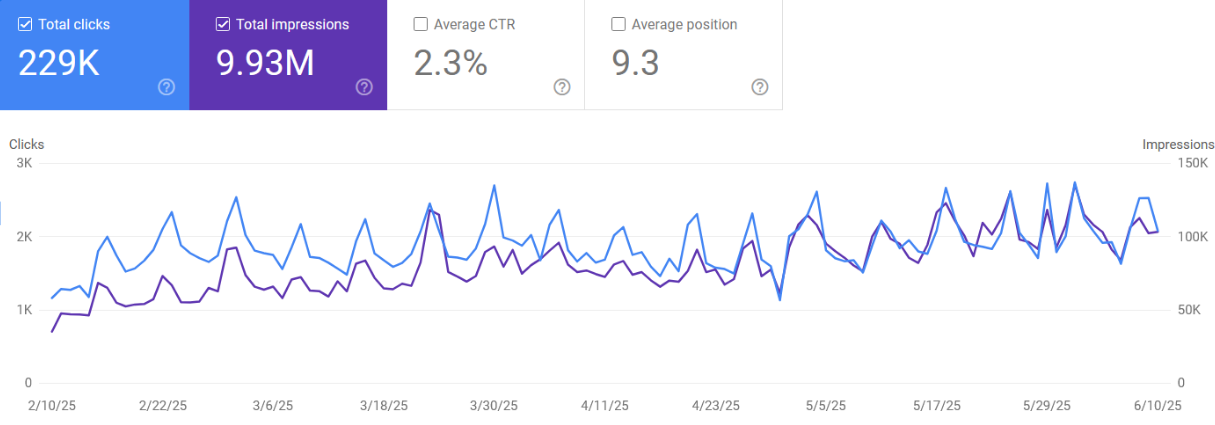
Organic impressions recovered to 100K+ per day, exceeding pre-redesign levels once category and template work compounded.
For Shopify-specific proof, Hajusuola.fi held average position 1.2 over 16 months on a single-product store; for a new-domain launch, see Ostapuhelin's top-five rankings in six months. The three cases sit at different points of the ecommerce spectrum (recovery, platform optimisation and greenfield launch) but the underlying discipline is the same: fix architecture and indexation before layering on content.
Trust signals that support ecommerce E-E-A-T
Google evaluates trust beyond backlinks for transactional sites. These are the client-side signals we check on every ecommerce audit: yours, not ours. We surface and structure them; we never fabricate or imply a licence, registration or review volume a store does not actually hold.
DED/DET trade licence displayed
A visible ecommerce trade licence: issued by the Department of Economic Development, now the Dubai Department of Economy and Tourism, gives first-time visitors comparing you to Noon or Amazon.ae a legitimacy signal most independent stores skip.
VAT registration (TRN) shown
A visible Tax Registration Number, issued by the UAE Federal Tax Authority, on checkout and invoice pages reassures business buyers and repeat customers that they are dealing with a properly registered UAE entity, not an unlicensed reseller.
Genuine review volume surfaced
Review counts and ratings shown on category and product pages (not hidden behind a separate testimonials page) carry more weight for both shoppers and Google than a five-star badge with no visible volume behind it.
Clear payment and returns policy
Accepted payment methods, cash-on-delivery availability and return or refund terms linked from every product and category page, not buried in a single FAQ three clicks deep: a basic trust signal marketplaces standardise and many independent stores skip.
Shopify, WooCommerce and custom-stack notes
Most Dubai online stores run on Shopify, WooCommerce or a custom-built and increasingly headless stack, often synced to a separate ERP, POS or inventory system. Each platform creates distinct SEO constraints that a generic "ecommerce SEO" checklist glosses over.
Shopify. The forced /collections/ and /products/ URL structure, automatic tag-based collections and third-party app scripts are the most common source of crawl waste we see. Liquid theme constraints mean canonical tags, structured data and even basic heading hierarchy sometimes need developer-level template edits rather than a plugin toggle, which is why Santeri briefs your developer directly on Shopify engagements and follows up until the work ships.
WooCommerce. WooCommerce inherits WordPress's flexibility, and its risk, in equal measure. Plugin stacking for payment gateways, shipping calculators and multi-currency pricing routinely slows Core Web Vitals scores and can duplicate category URLs through parameter-based filtering add-ons. We audit the plugin stack for SEO conflicts before recommending new content work, since a fast, clean template outperforms a content calendar layered on a page that takes six seconds to load.
Custom-built and headless stores. Custom React, Next.js or headless commerce builds solve performance problems Shopify and WooCommerce cannot, but shift SEO risk toward rendering: server-side rendering gaps, client-side routing Google cannot follow, and dynamic sitemaps that drift out of sync with the live catalogue. A technical SEO review before launch, not after, is the only reliable way to catch these issues on a custom stack, and it is far cheaper than untangling an indexation problem six months into a new build.
Whichever platform a store runs on, the underlying discipline stays the same: architecture and indexation get fixed before content production scales, because publishing category copy onto a broken template just produces more pages Google will not reliably crawl.
Ready for a prioritised list of ecommerce SEO fixes?
Enter your website below. We'll reply next business day with what's actually holding back organic visibility: faceted navigation, indexation gaps or thin category content.
You'll get a written reply, not a generated report.
SEO packages for ecommerce businesses
Ecommerce scope scales with SKU count, platform constraints, business model and whether a redesign recovery is needed. Growth and Dominate tiers suit most catalogues with 500+ products; marketplace-dependent sellers building an owned channel from a smaller base can often start on Foundation. Redesign-recovery work is scoped separately once we have seen the extent of the indexation damage, since a store that lost 20% of its category pages needs a different plan to one that lost 80%. Compare packages from AED 999 per month or start with a free audit to see where indexation and architecture leak revenue. For the broader case on committing budget to organic, see why invest in SEO.
Ecommerce and retail SEO questions
How is ecommerce SEO different in the UAE compared to Europe?
UAE shoppers add modifiers around cash on delivery, same-day delivery and mall-vs-online comparison, and marketplace competition from Noon and Amazon.ae shapes click-through in ways most European playbooks do not anticipate. Category architecture needs to account for Arabic query variants and mobile-first checkout behaviour from day one.
Can Shopify stores rank well in Dubai?
Yes, with deliberate architecture. Shopify's default collection structure, faceted navigation and app bloat create crawl and indexation problems if left unmanaged. We restructure collections, manage canonical rules and optimise within theme constraints, our Hajusuola engagement held an average position of 1.2 over 16 months on a single-product Shopify store.
What is faceted navigation and why does it hurt ecommerce SEO?
Faceted filters (size, colour, price, brand) generate thousands of URL combinations from one category page. Without noindex or canonical rules, Google wastes crawl budget on thin duplicates and may not index your main category URLs. Controlling faceted nav is often the highest-impact technical fix for large catalogues.
Should UAE ecommerce sites target Amazon and Noon or focus on owned traffic?
Marketplaces provide volume but compress margin and hide customer data. Owned-site SEO builds direct repeat purchase and brand search defence. Most retailers need both: marketplace for discovery, owned site for loyalty, bundles and higher-margin SKUs.
How does Ramadan affect ecommerce SEO planning?
Search patterns shift: gifting, iftar-related products, home entertainment and post-Eid shopping peaks. Content and category pages should be live before Ramadan starts, not published mid-month. Historical Search Console data helps forecast which categories move and when.
What happened after the furniture store redesign?
A furniture ecommerce client lost visibility after a redesign that broke indexation and category structure. Recovery work restored 100,000+ daily impressions once technical issues were resolved and category architecture was rebuilt. Read the full case study for baseline, timeframe and methodology.
Do we still need SEO if most of our sales come through Noon or Amazon.ae?
Marketplaces are a distribution channel, not a substitute for owned search visibility. Noon and Amazon.ae control the customer relationship and cap your margin with referral fees, and can change ranking rules or policy without notice. SEO on your own site builds branded search defence, direct repeat purchase and content marketplaces will not let you publish: buying guides, comparisons, brand story. Most marketplace-first sellers we work with keep listings for volume while building the owned site as a margin-recovery channel.
How should out-of-stock products be handled for SEO?
Deleting the page and returning a 404 wastes any ranking and link equity it earned. Where the product will return, keep the page live, mark availability clearly in schema and on-page copy, and offer close alternatives or a restock notice. Where it is discontinued permanently, redirect to the closest matching category or replacement product rather than leaving a dead end or blanket-redirecting everything to the homepage.
More background on search fundamentals: SEO fundamentals and what is SEO. See more UAE results across industries in our case studies.
Not sure what to fix first?
Enter your website and we'll review it by hand. You'll get a short, specific list of what's holding your rankings back. Reply typically next business day. No obligation, and no follow-up unless you want one.